
Kufic Script and the Continuum Hypothesis
1. Kufic Script as Geometry of Infinity
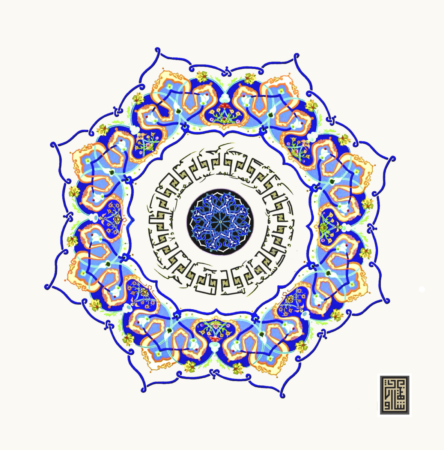
The Kufic Fatiha design embodies a profound dialogue between the discrete and the continuous.
– Each elongated square module of the script is a discrete element, a finite glyph that can be counted, enumerated, and arranged. These units echo the rhythm of the natural numbers: distinct, sequential, and modular.
– Yet, when these squares are curved into a circular mandala, they transcend their discreteness. The circle is not merely a sum of squares—it is a continuous flow, a seamless unity that cannot be reduced to enumeration.
Thus, Kufic geometry becomes a visual metaphor for infinity: the tension between the countable and the uncountable, between the finite glyph and the infinite utterance.
—
2. The Continuum Hypothesis (CH)
Mathematically, this tension is captured by the Continuum Hypothesis (CH), one of the deepest riddles in set theory.
The Ladder of Infinities
– ℵ₀ (aleph-null): The cardinality of the natural numbers, the smallest infinity—countable, discrete, enumerable.
– ℵ₁ (aleph-one): The next cardinality, the smallest uncountable infinity.
– \(2^{\aleph_0}\): The cardinality of the continuum, the real numbers—uncountable, continuous, seamless.
CH asks:
\[
\text{Is } 2^{\aleph0} = \aleph1?
\]
In other words, is the continuum exactly the next infinity after the countable, with no intermediate size?
—
Independence and Pluralism
– Gödel (1940) showed CH cannot be disproved from the axioms of set theory (ZFC).
– Cohen (1963) showed CH cannot be proved from ZFC.
Together, they revealed CH is independent of ZFC: it can be assumed true or false, and both choices yield consistent mathematical universes. This discovery shattered the dream of a single, absolute mathematical reality. Instead, mathematics became pluralistic, admitting multiple coexisting models of infinity.
—
3. Philosophical Implications
– Mathematical truth is not absolute: CH shows that truth depends on the axioms we adopt.
– Infinity is layered: Not one monolithic concept, but a spectrum of possibilities.
– The continuum is transcendent: It cannot be reached by counting—it is a leap, not a bridge.
This resonates with metaphysical traditions: the unity of the circle transcends the discreteness of its squares, just as the continuum transcends the countable.
—
4. Kufic Geometry as CH Metaphor
– Squares = ℵ₀: Countable, modular, linguistic units.
– Circle = \(2^{\aleph_0}\): Continuous, holistic, divine unity.
– No intermediate glyphs = CH: No intermediate cardinalities.
The design embodies CH visually: the leap from discrete to continuous, from enumeration to transcendence, from multiplicity to unity.
—
5. Metaphysical Reading
The Continuum Hypothesis is not only a mathematical statement—it is a mystical axiom:
– The infinite cannot be approached by counting.
– The whole is not the sum of its parts.
– The Real (\(\mathbb{R}\)) is not a limit—it is a revelation.
In this way, CH mirrors the Sufi notion of tawhid: the Oneness of Being, beyond enumeration, beyond intermediaries, beyond proof.
—
Kufi Yazı ve Süreklilik Hipotezi
1. Kufi Yazı: Sonsuzluğun Geometrisi
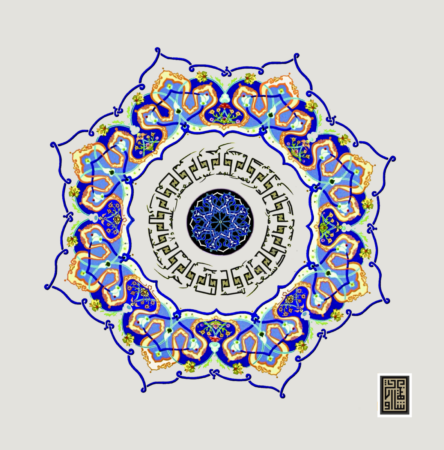
Fatiha’nın Kufi tasarımı, kesikli ile süreklinin derin diyaloğunu taşır.
– Her bir uzatılmış kare modül, kesikli birimdir: sayılabilir, düzenlenebilir, tekrarlanabilir. Bu kareler, doğal sayıların ritmini hatırlatır: ayrı ayrı, ardışık ve modüler.
– Ancak bu kareler bir daire mandalasına dönüştüğünde, kesikliliği aşar. Daire artık karelerin toplamı değildir; o, sürekli bir akış, parçalanamaz bir birliktir.
Böylece Kufi geometri, sonsuzluğun görsel metaforu olur: sayılabilir ile sayılamazın, sonlu harf ile sonsuz anlamın gerilimi.
—
2. Süreklilik Hipotezi (CH)
Matematikte bu gerilim, Süreklilik Hipotezi (CH) ile ifade edilir; küme teorisinin en derin bilmecelerinden biridir.
Sonsuzluk Merdiveni
– ℵ₀ (aleph-sıfır): Doğal sayıların kardinalitesi, en küçük sonsuzluk—sayılabilir, kesikli, ardışık.
– ℵ₁ (aleph-bir): Bir sonraki kardinalite, en küçük sayılamaz sonsuzluk.
– \(2^{\aleph_0}\): Sürekliliğin kardinalitesi, reel sayılar—sayılamaz, kesintisiz, bütüncül.
CH sorar:
\[
\text{Acaba } 2^{\aleph0} = \aleph1 \text{ midir?}
\]
Yani, süreklilik tam olarak sayılabilirden sonraki sonsuzluk mudur, yoksa arada başka bir büyüklük var mıdır?
—
Bağımsızlık ve Çoğulculuk
– Gödel (1940): CH’nin ZFC aksiyomlarından çürütülemeyeceğini gösterdi.
– Cohen (1963): CH’nin ZFC’den ispatlanamayacağını kanıtladı.
Sonuç: CH, ZFC’den bağımsızdır. Doğru kabul edilebilir, yanlış kabul edilebilir; her iki durumda da tutarlı matematik evrenleri kurulur. Bu keşif, tek ve mutlak bir matematik evreni hayalini yıktı. Yerine çoğulculuk geldi: birbirine zıt ama tutarlı sonsuzluk modelleri.
—
3. Felsefi Yansımalar
– Matematiksel hakikat mutlak değildir: CH, hakikatin seçilen aksiyomlara bağlı olduğunu gösterir.
– Sonsuzluk katmanlıdır: Tek bir kavram değil, olasılıkların spektrumu.
– Süreklilik aşkındır: Sayarak ulaşılamaz; köprü değil, sıçramadır.
Bu, metafizik geleneklerle buluşur: karelerin kesikliliğini aşan daire birliği, tıpkı sayılabilirden sayılamaza sıçrayış gibi.
—
4. Kufi Geometri ve CH Metaforu
– Kareler = ℵ₀: Sayılabilir, modüler, dilsel birimler.
– Daire = \(2^{\aleph_0}\): Sürekli, bütüncül, ilahi birlik.
– Ara biçimlerin yokluğu = CH: Ara kardinalitelerin yokluğu.
Tasarım, CH’yi görsel olarak somutlar: kesikliden sürekliliğe, çokluktan birliğe, saymadan vahdete sıçrayış.
—
5. Metafizik Okuma
Süreklilik Hipotezi yalnızca matematiksel bir önerme değildir; aynı zamanda bir mistik aksiyomdur:
– Sonsuzluk sayarak yaklaşılmaz.
– Bütün, parçaların toplamı değildir.
– Gerçek (\(\mathbb{R}\)) bir sınır değil, bir tecellidir.
Böylece CH, tevhid anlayışını yansıtır: Varlığın Birliği, saymanın ötesinde, aracısız, ispatın ötesinde.
Bach’ın notaları bir Mobius şeridi üzerindeki gibi bila fasıla icra edilebilen Crab Canonu…Goedel ve Escher yorumlarıyla birlikte
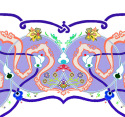
Fatiha deseni içinde “deymûmet”/”continuum hipotezi”ni ve sonsuzluğu sembolize eden Mobius şeridi: buradaki bach müziğinin sonunda nota kağıdı üzerinde de gösterildiği gibi bu şeridin kıvrılıp bükülmesi ve iki ucunun birleştirilmesi sayesinde bir yüzeyinde başlayan hareket fasılasız olarak daimi şekilde öteki yüze geçerek hiç sona ermeden devam eder. bu deymumet/sonsuzluk sembolü fatihanın tezhibindeki motifler arasında da, fatihanın istifinde de, fatiha yazısının yarısından sonra dairenin iç yüzüne geçip ters istikametde devam etmek şeklinde bir deymumeti vardır tıpkı Bach’ın başı sonuna bitişip ters istikamette devam eden bu müziği gibi bir sonsuzluk sembolüdür. Bu fatiha istifi dahi, istidare -i zaman teorisinin “nokta anlar”ı ve mezkur sonsuzluk sembolleri gibi bir çok matematik hikmetini muhtevidir vesselam… ezcümle bu fatihayı bihakkın anlayarak temaşa etmek için burada linklerini verdiğim dangerous knowledge ve Bach,Escher, Godel derslerini izlemek ve benim varlığın anlamı kitabını okuyup anlayıp hazmetmek gerektir. velhasıl be-gaayet vâsi’ ilim lâzım âmed vesselam… şüd temâm.
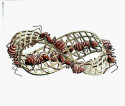
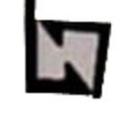
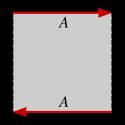
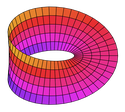
wikipedia mobius strip maddesinden
.
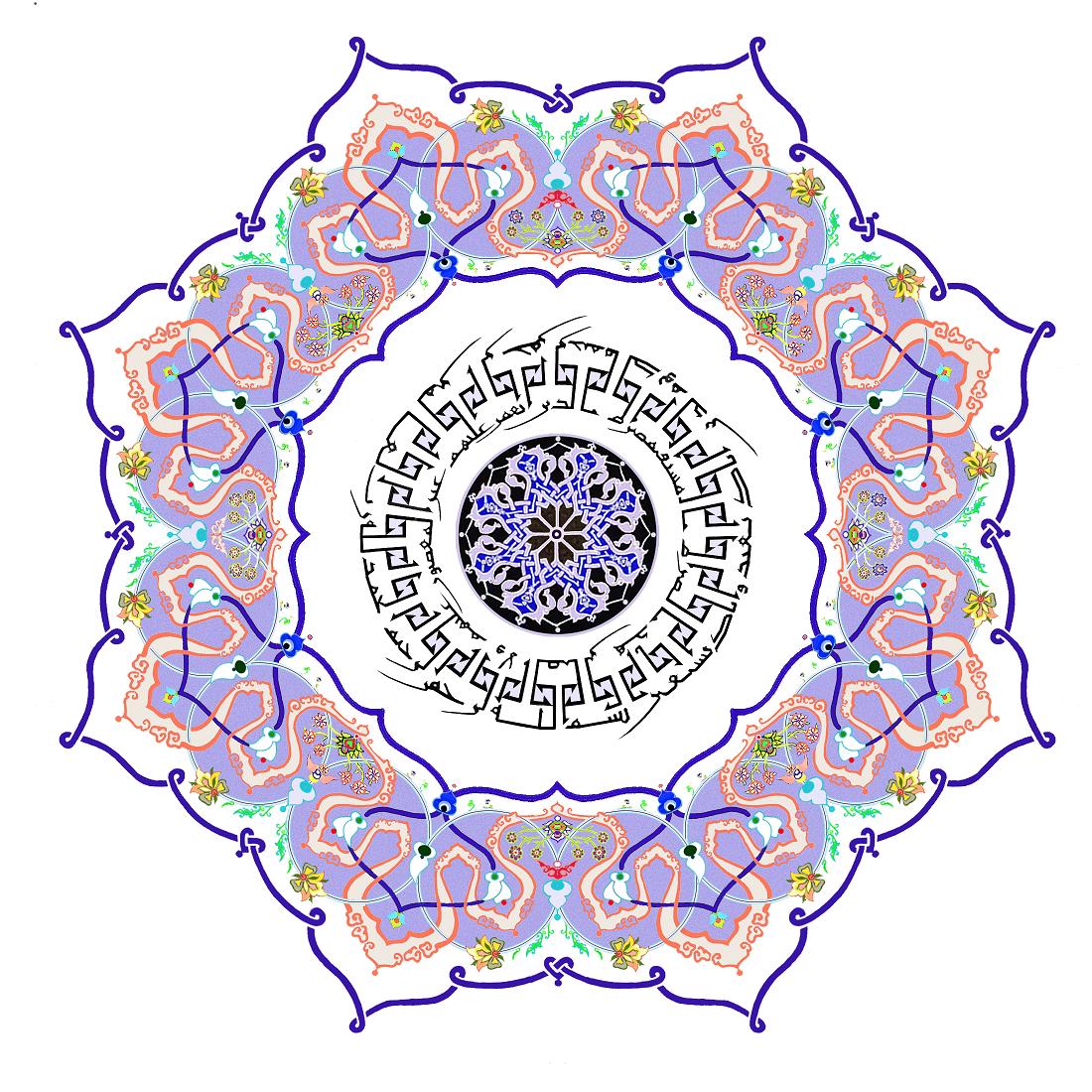
Draw a circle! Every circle includes infinite reference points; but what if, you draw a bigger circle which covers the first one. Then, according to set theory, there are bigger infinities than any infinity & this idea is proved mathematically, though it is self-contradictory. To resolve this paradox, the continuum hyphothesis comes into play which is neither provable nor unprovable. according to Cantor this paradox is resolvable only in God. if you wish to understand what I say, Read the book “varlığın Anlamı”and watch these documentaries…
bu fatiha designini anlamak için kılavuz: youtube da izlenebilen godel escher bach konferansının linki:
Philosophy, Physics, Mathematics – “Dangerous Knowledge”:
To see a world in a grain of sand,.
 And a heaven in a wild flower,.
Hold infinity in the palm of your hand,
And eternity in an hour.
Metafizik bir ilham ile set teorisini inşa eden büyük matematikçi George Cantor’un nasıl delirdiğini ve set teorisinin ve sonsuzluk kavramının problemlerini çözmek için geliştirdiği continuum hipotezinin hem yanlış hem doğru olduğunu isbatlayarak nasıl gittikçe daha rahatsız hale gelip ömrünü bir tımarhanede tamamladığını anlatan bir BBC belgeseli…belgeselin devamında , Boltzman, Goedel, ve Turing gibi dahilerin ayni fizikî realite ve matematik paradokslarıyla uğraşmaları sebebiyle yaşadıkları sosyal ve ruhi trajediler anlatılıyor.
Bu kitapta tartışılan matematik, mantık ve fizikî realite paradoksları ve ilgili argümanları daha iyi anlamak için, ek bilgi olarak, fevkalade faydalı bir belgesel… .bu kitaba bir annex gibi telakki ederek izlenebilir.